
Power Factor Panel Repair Service in Delhi
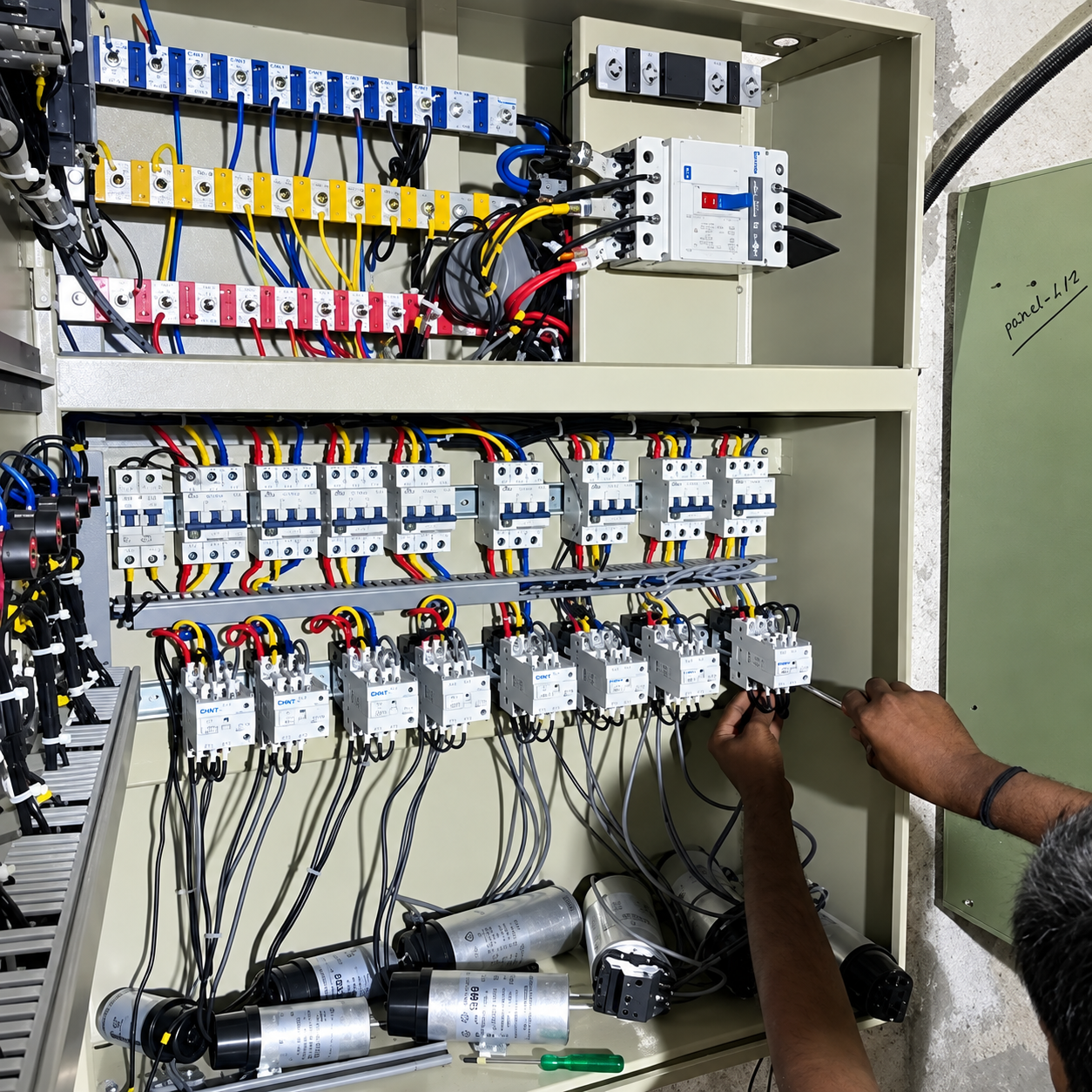
Fast, Reliable Power Factor Panel Repair Service in Delhi
When an APFC panel fails, it affects far more than a single component — low power factor penalties, capacitor stage failures, relay errors and tripping panels all add up to lost efficiency and disruption. Transparent Infra And Energy Solutions provides a dedicated Power Factor Panel Repair Service in Delhi for industrial and commercial sites that need fast, technically sound restoration of their power factor equipment.
Our engineers diagnose the root cause — whether it is a failed capacitor, a burned contactor, a faulty APFC relay, blown fuses, a wiring fault or a control logic issue — and recommend the right repair rather than a temporary patch. Every repair is verified under representative load before handover.
Book a Repair Visit ↗What Is a Power Factor Panel — And Why It Needs Expert Repair
Before booking a power factor panel repair service in Delhi, it helps to understand what the panel actually does — and why repairing it correctly matters to your electricity bill, your equipment life and your DISCOM compliance.
A power factor panel — also called an APFC (Automatic Power Factor Correction) panel — is an electrical assembly that automatically switches capacitor stages in and out of the circuit to keep your facility's power factor close to unity. It contains a controller or APFC relay, current transformers (CTs), capacitor duty contactors (CDCs), HRC fuses, MCCBs, capacitor banks, busbars, and control wiring.
When all components work correctly, the panel compensates for reactive power drawn by motors, transformers, induction furnaces, HVAC systems and other inductive loads. The result is a higher power factor, lower kVA demand, reduced line losses and — critically for Delhi businesses — no low-power-factor penalty from BSES, Tata Power DDL or NDMC.
However, capacitors age, contactors weld, relays drift, fuses blow and busbars loosen. When any component fails, the panel either stops compensating (power factor drops) or over-compensates (leading power factor, resonance, tripping). That's when a technically sound power factor panel repairing service in Delhi becomes essential.
Core Components Inside a Power Factor Panel
- APFC Relay / Controller — measures PF and decides which capacitor step to switch.
- Current Transformers (CTs) — provide current feedback to the controller.
- Capacitor Duty Contactors (CDCs) — switch capacitor stages safely.
- Capacitor Banks — supply reactive power (kVAr) to the load.
- HRC Fuses & MCCBs — protect each stage and the main busbar.
- Busbars & Control Wiring — distribute power and control signals.
- Detuned Reactors (if fitted) — protect capacitors from harmonics.
- Cooling Fans & Ventilation — maintain safe panel temperature.
Why Timely Power Factor Panel Repair Matters in Delhi
A failed power factor panel is not just an inconvenience — it directly hits your operating cost, equipment health and statutory compliance. Here is why Delhi businesses should not postpone repair.
1. Avoid DISCOM Penalties
Delhi DISCOMs (BSES Rajdhani, BSES Yamuna, Tata Power DDL, NDMC) levy low-power-factor penalties when PF falls below the prescribed threshold. A failed panel can push your PF below 0.85 within days, adding lakhs to your monthly bill.
2. Reduce kVA Demand Charges
Correcting power factor reduces the kVA drawn from the grid, which can directly lower your maximum demand charges — one of the largest line items in industrial and commercial electricity bills.
3. Prevent Cable & Transformer Overloading
Poor power factor increases current for the same kW load, causing cables, transformers and switchgear to run hotter, age faster and lose capacity. Repair restores normal current flow.
4. Stop Nuisance Tripping
Over-compensation and harmonic resonance cause unexplained tripping of capacitor breakers, main breakers and plant machinery. Repair with harmonic analysis eliminates the root cause.
5. Protect Capacitors From Damage
Leaving a panel with a faulty relay or wrong CT wiring causes capacitors to switch erratically, fail early and sometimes burst. Early repair saves both capacitor cost and downtime.
6. Extend Switchgear Life
Undersized or welded contactors, loose busbars and burnt terminals are fire risks. Proper power factor panel repair in Delhi re-terminates, re-torques and validates the entire panel.
Types of Power Factor Panels We Repair in Delhi
Our engineers repair all common power factor panel configurations used in Delhi's industrial, commercial and infrastructure sites.
| Panel Type | Typical Application | Common Repair Scope |
|---|---|---|
| Automatic APFC Panel | Factories, offices, malls, hospitals | Relay, CT, CDC, capacitor stage repair & recalibration |
| Fixed Capacitor Panel | Small workshops, pump houses | Capacitor replacement, fuse and MCCB repair |
| Detuned APFC Panel | Plants with VFDs, UPS, rectifiers | Reactor inspection, capacitor & harmonic filter repair |
| Hybrid / SVG-Assisted Panel | Precision industries, data centres | Integration check, controller repair, filter tuning |
| MCC-integrated PFC Panel | Manufacturing lines | Stage wiring repair, control logic restoration |
| LV & MV PFC Panels | Large plants, utilities | Protection coordination, relay repair, panel re-testing |
Delhi-Specific Challenges That Cause Power Factor Panel Failures
Delhi's climate, grid and load profile create failure patterns that are different from cooler or less harmonic-heavy regions. Repair work must address these local factors.
- Extreme summer heat (45°C+): accelerates capacitor ageing, relay drift and contactor coil failure.
- Dust and pollution: chokes panel ventilation, causes tracking on busbars and increases temperature rise.
- Monsoon humidity: leads to corrosion, insulation resistance drop and control-circuit faults.
- Harmonic-rich loads (VFDs, UPS, rectifiers, LED lighting): cause capacitor overheating, fuse blowing and resonance.
- DISCOM PF penalty thresholds: BSES/Tata DDL penalise below 0.85–0.90 — no margin for a degraded panel.
- Fluctuating grid voltage: causes frequent capacitor switching and faster contactor wear.
- Ageing installed base: many Delhi panels are 8–15 years old and need component-level restoration.
- Mixed single-phase and three-phase loads: cause unbalanced PF that confuses single-CT controllers.
Signs Your Power Factor Panel Needs Repair in Delhi
A power factor panel rarely fails without warning. Early symptoms usually show up in your electricity bills, your controller display and the condition of components inside the panel. Recognising these signs early keeps repair costs low and avoids a complete panel failure.
- Low power factor readings on the APFC relay or controller, even when the panel is switched on.
- Utility penalty notices for low power factor or reactive power charges on recent bills.
- Frequent fuse blowing on capacitor stages — a strong indicator of ageing capacitors or switching issues.
- Contactor chatter or humming, welded contacts or contactors that do not drop out correctly.
- APFC controller alarms, blank displays, erratic step switching or communication errors.
- Overheating, burnt terminals, discoloured busbars or a burning smell near the panel.
- Bulging or leaking capacitors, swollen capacitor cases or visible damage to terminal covers.
- Unexplained tripping of the main breaker or capacitor-stage breakers at specific times of the day.
If you are seeing any of these symptoms, a diagnostic visit is the fastest way to avoid a complete panel outage. Our power factor panel repairing service in Delhi begins with measurement and inspection — not guesswork.
What Our Power Factor Panel Repair Service Covers
We repair and restore every major component inside a power factor correction panel — from the controller down to the capacitor stages, switching devices and protective equipment.
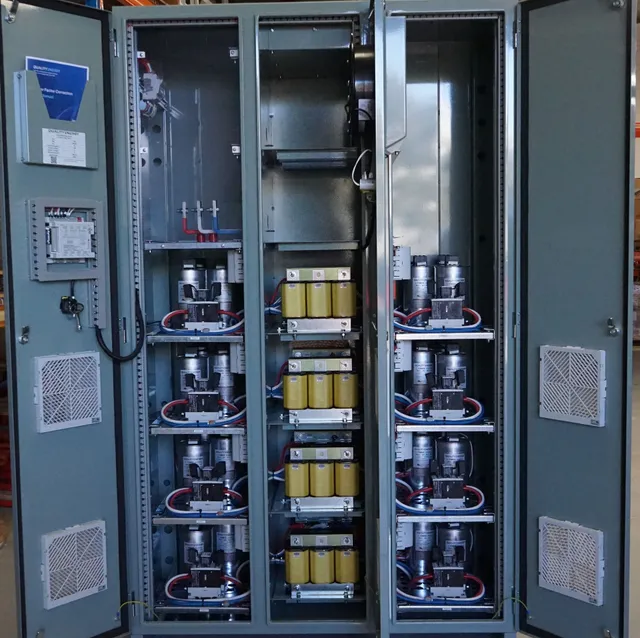
APFC Relay & Controller Repair
Diagnosis and repair of faulty APFC relays, controllers, CT inputs, display boards and communication faults. We test step switching logic and recalibrate target power factor settings.
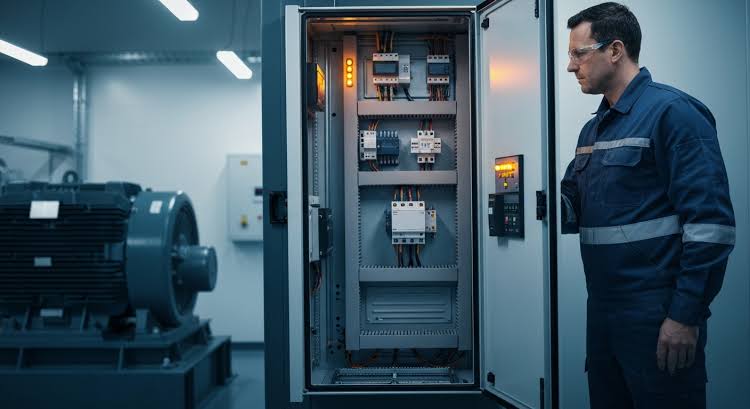
Capacitor Bank Repair & Replacement
Identification of weak, bulged or leaking capacitors. We replace failed capacitor stages with correctly rated units and verify kVAr output against the panel design.
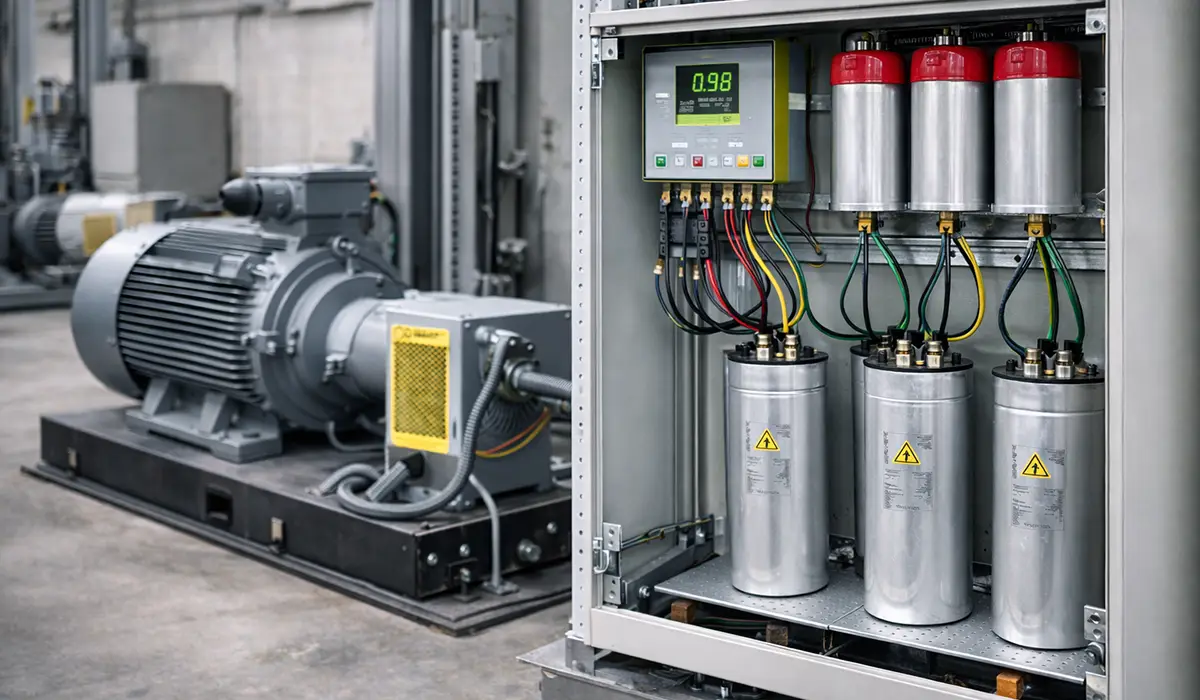
Capacitor Duty Contactor Repair
Replacement of welded, chattering or burned capacitor duty contactors (CDC) with suitably rated devices, including pre-charge resistors where applicable.

Fuse, Breaker & Protection Repair
Restoration of HRC fuses, MCCBs, MCBs, thermal relays and control-circuit protection. Fault-level and coordination checks help prevent repeat failures.
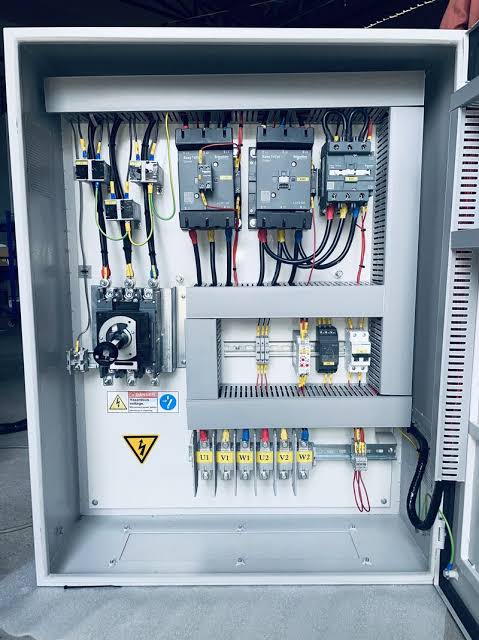
Panel Wiring, Busbar & Terminal Repair
Repair of loose connections, burnt terminals, damaged busbars and control wiring. Torque checks and insulation tests confirm safety before re-energisation.
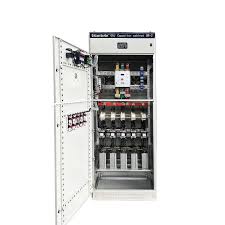
Harmonic & Power Quality Diagnosis
Where failures repeat, we measure harmonics and voltage distortion to determine whether the panel needs detuned reactors, filter tuning or replacement capacitor ratings.
Common Faults in Power Factor Panels — An In-Depth Breakdown
Understanding how each fault develops helps you recognise it early. Below are the faults our power factor panel repair service in Delhi team encounters most frequently, with the technical explanation behind each.
Capacitor Degradation
Capacitors lose capacitance gradually as the dielectric ages. Internal pressure builds up as the self-healing process breaks down, eventually causing bulging, leakage or ruptures. Older dry-type capacitors in Delhi's high ambient temperatures degrade 2–3× faster than in cooler climates.
APFC Relay Drift & Failure
Relay CT inputs can lose calibration, the display may blank out, and switching logic may become erratic. Causes include voltage spikes, harmonic distortion in CT secondary, moisture ingress and relay firmware wear. Controllers must be recalibrated against the actual load.
Capacitor Duty Contactor (CDC) Failure
CDCs carry large inrush currents at every switching event. Repeated switching welds contacts, degrades pre-charge resistors and burns coils. Symptoms include chatter, humming, drop-out delays and overheating — often confused with "capacitor failure."
Fuse Blowing on Capacitor Stages
HRC fuses blow because of capacitor breakdown, harmonic overload, loose terminals or wrong fuse rating. Repeated fuse failures are a clear indicator that the underlying fault must be diagnosed — not just re-fused.
Loose Busbar Joints & Burnt Terminals
Thermal cycling loosens busbar joints and cable terminations. Resistance rises, temperature climbs and oxidation accelerates — eventually causing a burnt terminal or fire risk. Thermal scanning during repair reveals hidden hotspots.
Harmonic Resonance
When capacitor banks are added to a network with high harmonic distortion, a parallel resonance can amplify harmonic currents 5–20×. Capacitors overheat and fail rapidly; breakers nuisance-trip. Detuned reactors or filter tuning are often required.
APFC Panel Repair Service in Delhi
Automatic Power Factor Correction panels are the backbone of reactive power compensation in modern facilities. Our APFC panel repair service covers every component, control loop and switching stage.
An APFC panel that is not switching stages correctly — or is switching them erratically — silently bleeds money through penalties and losses. We begin every APFC panel repair in Delhi with a structured diagnosis: verifying CT ratio and polarity, checking the relay's target-PF and step-time settings, measuring capacitor kVAr per stage, and inspecting contactor and protection health.
Repairs typically include relay replacement or re-commissioning, CT replacement, capacitor stage replacement, contactor replacement, wiring correction, fuse and MCCB restoration, and full functional testing under load. Where the panel design itself is inadequate (for example, too few steps for the load profile), we propose a staged retrofit so the controller can follow the load more precisely.
Capacitor Bank Repair & Replacement Service in Delhi
The capacitor bank is the heart of the power factor panel — and the component most affected by heat, harmonics and age.
What We Do
- Measure capacitance and ESR of every capacitor to detect weak or failed units.
- Check kVAr output against nameplate and panel design to identify under-performance.
- Replace failed or bulging capacitors with correctly rated MPP / APP / heavy-duty units.
- Verify stage fuses, contactors and discharge resistors.
- Balance stages so switching produces smooth, uniform kVAr steps.
- Recommend detuned reactors where harmonic distortion is shortening capacitor life.
Signs Your Capacitor Bank Needs Repair
- Power factor remains low even with panel ON.
- Capacitors feel hot to touch or show bulged tops.
- Oil leakage or staining near capacitor terminals.
- Repeated fuse blowing on one or two specific stages.
- Burnt smell or charred insulation around capacitor cans.
- kVAr reading on the controller is much lower than expected.
APFC Relay Repair & Controller Calibration in Delhi
The APFC relay is the "brain" of the panel. If the relay is misconfigured or faulty, even a healthy capacitor bank will not deliver the expected power factor.
Relay Diagnosis
We use the relay's diagnostic menu, inject test signals into the CT circuit and compare readings against calibrated instruments. Faulty CT polarity, wrong CT ratio and control wiring are common causes of "apparent relay failure."
Repair or Replacement
Where a relay is repairable (loose terminals, blown internal fuse, display board), we repair it. Where firmware or hardware failure is confirmed, we replace with a compatible model and re-commission from scratch.
Calibration & Commissioning
Target power factor, step switching delays, CT ratio, number of steps, discharge timing and alarm thresholds are all calibrated to your actual load. We verify behaviour under light, medium and peak load.
Capacitor Duty Contactor (CDC) Repair in Delhi
CDCs are specially designed to handle the high inrush current of capacitor switching. Standard contactors used in their place fail very quickly — a common retrofit mistake we correct.
We inspect contact condition, coil voltage, pre-charge resistance and duty rating. Welded contacts, humming coils and delayed drop-out are repaired or replaced with correctly rated capacitor-duty contactors. Where a panel has been built using standard contactors, we recommend upgrading all switching devices to true CDCs to eliminate repeated failures.
Post-repair, every CDC is tested for pick-up voltage, drop-out voltage, contact resistance and switching time against the controller's command. Only then is it returned to service.
Fuse, MCCB & Protection Device Repair in Delhi Power Factor Panels
Protection devices are the panel's immune system. If they are under-sized, over-sized or worn, the panel is either vulnerable to damage or prone to nuisance tripping.
- HRC fuse rating verification against capacitor kVAr and prospective fault current.
- MCCB / MCB trip-curve review and coordination with upstream breakers.
- Replacement of welded, charred or unreliable protective devices.
- Thermal overload relay testing and re-setting for stage current.
- Control-circuit fuse and MCB restoration.
- Earth-fault protection check on PFC panels with sensitive earth leakage.
- Discharge resistor verification to confirm safe re-switching.
- Interlocking and E-stop circuit testing.
- Fault-level study to determine whether the protection scheme itself needs revision.
- Documentation of every protective device setting for future maintenance.
Panel Wiring, Busbar & Terminal Restoration in Delhi
Even when all active components are healthy, a power factor panel can fail because of loose terminals, corroded busbars or damaged control wiring. Our repair scope includes complete electrical restoration of the panel's internal infrastructure.
- Re-termination of loose power and control cables with correct lugs.
- Busbar inspection for pitting, tracking, discolouration and oxidation.
- Re-torquing of every bolted joint to manufacturer-specified values.
- Replacement of damaged control wiring, ferrules and labels.
- Insulation resistance (IR) tests on main and control circuits.
- Continuity and polarity verification of the entire control loop.
Why This Matters
Most "intermittent" panel faults — random tripping, blank controller displays, contactor chatter — trace back to a loose or corroded terminal. A proper power factor panel repair in Delhi must include electrical infrastructure restoration, not just component swap.
Harmonic Analysis & Detuned Reactor Solutions
Repeated capacitor failures are often a symptom of harmonics, not capacitor quality. Our engineers measure harmonic distortion, identify resonance risks and recommend the right correction.
We use power quality analysers to record voltage and current harmonics (THD-V, THD-I), individual harmonic orders, flicker, unbalance and voltage distortion. Where the harmonic spectrum falls close to a resonant frequency with the panel's capacitor bank, detuned reactors (typically 7% or 14% tuned) or a tuned harmonic filter are recommended. In severe cases, an Active Harmonic Filter (AHF) or Static VAR Generator (SVG) may be appropriate.
If you are facing repeat capacitor failures, our power factor panel repair service in Delhi includes a harmonic study so you fix the cause — not just the symptom.
Power Factor Panel Repair Guide — Fault, Diagnosis & Outcome
This table summarises the most common power factor panel faults we repair in Delhi, how we diagnose each one, and the typical repair outcome after service.
| Symptom | Likely Cause | Diagnosis Method | Typical Repair | Expected Outcome |
|---|---|---|---|---|
| Low power factor despite panel ON | Failed capacitor stages, blown stage fuses | kVAr verification, capacitance test, fuse continuity check | Replace failed capacitors and fuses | Power factor restored close to target |
| Controller display blank or alarms | APFC relay fault, CT polarity or wiring issue | Relay diagnostic menu, CT ratio and polarity check | Relay repair/replacement, wiring correction | Accurate step switching restored |
| Contactors chatter or burn out | Undersized CDC, coil failure, control voltage issues | Coil voltage test, contact inspection, load-current check | Replace with suitably rated capacitor-duty contactor | Stable switching, no nuisance trips |
| Frequent fuse blowing on stages | Ageing capacitors, harmonic overload, loose terminals | Capacitance and ESR test, harmonic measurement | Replace capacitors, tighten terminals, recommend detuned reactors if harmonics present | Reduced fuse failures, stable operation |
| Overheating / burning smell | Loose busbar joints, undersized cables, poor ventilation | Thermal scan, torque check, ventilation review | Re-terminate joints, improve cooling, replace damaged parts | Temperature back to normal range |
| Panel trips only at specific times | Over-correction during light load, resonance with harmonics | Load-profile logging, harmonic spectrum analysis | Reconfigure steps, adjust controller settings, add detuned reactors if required | Stable operation across load variations |
| Leading power factor at light load | Oversized capacitor bank / too many steps ON | Compare kVAr switching against measured load | Re-size stages, tune controller switching thresholds | Power factor held near target without leading |
Power Factor Penalties in Delhi — What a Failed Panel Actually Costs You
Delhi DISCOMs charge a low-power-factor penalty when PF drops below the permitted limit. For a typical industrial or commercial consumer, the penalty can run into lakhs per month. A quick repair usually pays for itself within days.
Direct Penalty
BSES and Tata Power DDL typically penalise power factor below 0.85 to 0.90. The penalty is levied as a percentage of the energy or demand charges — often 1% to 5% of your monthly bill for every 0.01 drop below the threshold.
kVA Demand Impact
Poor PF increases the kVA demand recorded by the meter for the same kW load. Since demand charges are billed per kVA, a failed panel directly inflates demand charges every billing cycle.
Increased I²R Losses
Higher current at low PF increases thermal losses in cables, transformers and switchgear — energy that is paid for but delivers no useful work.
Reduced Equipment Life
Continuous operation at low PF causes transformer and cable overheating, leading to accelerated insulation ageing and earlier capital replacement.
If your recent Delhi electricity bill shows a low-PF penalty or a reactive-power charge, a diagnostic visit is the fastest way to stop the loss. Call +91 93136 20508 to schedule a repair.
Industries & Sectors We Serve Across Delhi NCR
Our power factor panel repair teams work across every major load profile in Delhi — from heavy industry to precision facilities.
Manufacturing & Fabrication
Welding, presses, CNC lines, motor loads — high harmonic and reactive-demand environments.
Commercial Buildings & Malls
HVAC, lifts, lighting — large inductive loads with strict DISCOM compliance requirements.
Hospitals & Healthcare
UPS, imaging systems, medical equipment — sensitive to harmonic distortion and voltage quality.
Data Centres & IT Parks
Rectifier-heavy loads, high THD-i, precise PF and reliability requirements.
Cold Storage & Food Processing
Compressors, refrigeration plants — high reactive demand and long operating hours.
Textile & Printing
Motor-driven machinery, VFDs, high harmonic spectra.
Hotels & Hospitality
HVAC, kitchens, laundry — mixed loads and seasonal PF swings.
Infrastructure & Real Estate
Construction sites, pumping stations, metro and utility facilities.
Emergency & Same-Day Power Factor Panel Repair in Delhi NCR
When a power factor panel fails during a critical production run, every hour of downtime costs money. Our emergency repair response is designed for these situations.
We coordinate priority site visits across Delhi NCR for panel failures that affect production, compliance or safety. Our engineers arrive equipped with diagnostic instruments and a stock of commonly required spares (capacitors, contactors, fuses, relays) so that most emergency repairs can be completed in a single visit.
For critical failures, call +91 93136 20508 directly and describe the symptoms — blank controller, tripping stages, burnt smell, low power factor alarm. We will advise initial safety steps and schedule the fastest possible visit.
Preventive Maintenance & AMC for Power Factor Panels in Delhi
A structured AMC eliminates most unplanned panel failures. Our preventive maintenance plans are designed around Delhi's heat, dust and harmonic environment.
Scheduled Inspection
Monthly or quarterly visits covering the full panel — controller, capacitors, contactors, fuses, busbars, cooling.
Thermal Scanning
Infrared scan of busbars, terminals and switching devices to catch hotspots before failure.
Component Testing
Capacitance and ESR testing of every capacitor stage; contactor contact resistance measurement.
Cleaning & Torquing
Panel cleaning, filter replacement and re-torquing of all bolted joints to reduce thermal faults.
Thermal Imaging & Predictive Diagnostics
Thermal imaging reveals faults that are invisible to the eye — loose joints, overloaded stages, failing contactors and degrading capacitors.
Our engineers use calibrated thermal imagers to scan the panel under normal load. A hotspot at a busbar joint, a warmer-than-normal capacitor can or a contactor running hotter than its neighbours are all early warnings. Catching these during a preventive scan usually avoids a complete failure and a costly emergency repair. Thermal scans are also included in our AMC scopes and in post-repair verification.
Why a Pre-Repair Power Quality Audit Matters
Jumping straight to component replacement is how the same fault recurs. Our repair workflow begins with a power quality audit so that the root cause is understood — not guessed.
The audit captures voltage and current profiles over a representative period, power factor behaviour across load levels, harmonic spectrum, unbalance and switching events. This lets us decide whether the fault is purely component-level, or whether the panel's design, controller settings or harmonic environment also need correction. The result is a repair that lasts — and a documented baseline against which post-repair performance can be verified.
Our Power Factor Panel Repair Process in Delhi
Every repair follows a structured process so that the correct root cause is addressed and the panel is returned to service safely.
1. Site Visit & Inspection
Our engineer visits the site, reviews the panel layout, inspects the controller, capacitors, contactors and protection, and records initial readings.
2. Fault Diagnosis
Measurements are taken on voltage, current, power factor and harmonics. Failed components are isolated and the root cause is identified before any replacement.
3. Repair & Replacement
Faulty capacitors, contactors, relays, fuses and wiring are repaired or replaced with correctly rated components. All terminations are re-torqued and tested.
4. Verification & Handover
The panel is energised and observed under representative load. Power factor readings, step switching and protective devices are recorded and shared with you.
Repair vs Replacement — How We Decide
Not every fault requires a new panel. Our engineers apply clear technical criteria to recommend repair, staged restoration or full replacement.
| Condition | Recommended Action | Reason |
|---|---|---|
| Isolated component failure | Repair & replace failed part | Rest of panel healthy, lower cost |
| 2–3 capacitor stages failed | Replace failed stages + verify others | Panel infrastructure intact |
| Relay / controller obsolete or unavailable | Relay replacement + re-commissioning | Rest of panel salvageable |
| Busbar / MCCB damaged | Staged restoration or retrofit | Component-level rebuild possible |
| Multiple harmonic-related failures | Repair + detuned reactors or filters | Fixing cause, not just symptom |
| Panel undersized for load profile | Redesign or upgrade | New requirement exceeds original design |
| Panel safety compromised | Full replacement | Risk to personnel and facility |
Spare Parts & Components We Supply & Fit
Our repair teams are backed by a parts inventory for fast turnaround. Where a specific brand or model is unavailable, we propose a technically equivalent alternative.
- Capacitors (MPP, APP, heavy-duty, gas-filled)
- Capacitor duty contactors (CDC)
- APFC relays & controllers
- Current transformers (CTs) — all ratios
- HRC fuses & fuse bases
- MCCBs and MCBs
- Thermal overload relays
- Detuned reactors & filter components
- Control transformers & SMPS
- Push buttons, indicators, selectors
- Panel cooling fans & filters
- Busbars, lugs, terminals and wiring
Safety Standards & Compliance Followed in Every Repair
Every repair follows recognised Indian and international electrical safety standards to protect personnel, equipment and your facility's compliance posture.
- IS 8623 / IEC 61439: LV switchgear and controlgear assemblies — panel construction and testing.
- IS 13340 / IEC 60831: Shunt power capacitors — rating and safety verification.
- IS 13947 / IEC 60947: LV switchgear and contactor compliance.
- CEA Regulations: Measures for safety and electric supply.
- Lockout–tagout (LOTO) before any work begins.
- Insulation resistance and earth continuity tests before re-energisation.
- Documentation of every repair with test results and photographs.
- Use of calibrated instruments for every measurement.
Post-Repair Load Testing & Verification
A repair is not complete until the panel has been verified under real load. Every job closes with a documented performance test.
Functional Test
Step switching observed at light, medium and peak load. Target PF achieved and held without oscillation. Relay display and alarms tested.
Measurement Test
Voltage, current, PF, THD and per-stage kVAr recorded using calibrated instruments. Results compared against pre-repair baseline.
Thermal Check
Post-load thermal scan of busbars, terminals, contactors and capacitors to confirm no hotspots remain.
Cost of Power Factor Panel Repair in Delhi — What Affects the Price
Every panel is different. Rather than quote a fixed price, we provide a transparent scope and cost after diagnosis. The main factors that determine repair cost are listed below.
- Number of failed components (capacitors, contactors, fuses, relay).
- Panel rating and number of stages — larger panels take longer.
- Brand and availability of spare parts for older or imported panels.
- Whether the relay or controller needs replacement vs recalibration.
- Harmonic study or detuned reactor recommendation if repeat failures are harmonic-driven.
- Site access and shutdown window (night shifts, weekends, production constraints).
- Panel condition — complete restoration vs targeted component repair.
- AMC bundling if you choose a preventive maintenance plan.
Call +91 93136 20508 or email transparentenergysolution@gmail.com with your site details for a transparent estimate.
Recent Power Factor Panel Repairs in Delhi NCR
A snapshot of typical repairs completed by our team. Site names are generic to respect confidentiality, but the technical scenarios are representative.
Okhla Industrial Area
Manufacturing unit with 400 kVAr APFC panel. Relay failure plus 3 failed capacitor stages. Repair restored PF from 0.79 to 0.97 — penalty removed next billing cycle.
Naraina Industrial Area
Printing press with recurring fuse blowing. Harmonic study identified 5th and 7th harmonic resonance. Detuned reactors installed; repeat fuse failures stopped.
Dwarka
Commercial complex with APFC panel tripping at low load. Over-compensation diagnosed; controller thresholds and step configuration corrected.
Bawana
Cold storage facility — CDCs welded and contactors chattering. Replacement with properly rated CDCs plus control wiring restoration.
Rohini
Hospital panel with blank controller. Relay replaced, CT polarity corrected, re-commissioned. Full functional verification under load.
Greater Kailash
Retail mall panel — burnt busbar terminals. Busbar restoration, terminal re-torquing and thermal scan post-repair; no recurrence.
Power Factor Panel Modernization & Retrofit Solutions
For older Delhi panels that repeatedly fail, modernization is often more cost-effective than repeated repairs.
We retrofit existing panels with modern APFC controllers, detuned reactors, heavy-duty capacitors and improved cooling — preserving the enclosure and busbar infrastructure while upgrading the electrical and control layers. Retrofit scopes are sized to your load profile so that the controller can follow the load more precisely. Modernization typically extends panel life by 8–10 years and often pays back within 12–18 months through reduced penalties and lower component failure rates.
Energy Monitoring & Smart Panel Upgrades
Smart panel upgrades let you see what is happening inside your power factor panel — without opening it.
Real-Time PF Monitoring
Energy meters and IoT-enabled monitors stream PF, kVA, kW, THD and stage-status data continuously.
Alerts & Logs
Alarms for low PF, stage failure, over-temperature or communication loss — before they escalate.
Performance Reporting
Monthly reports on PF trend, kVAr delivered vs demand and penalty exposure.
Monsoon & Summer Readiness Checklist for Delhi Power Factor Panels
Delhi's peak summer load and monsoon humidity each stress panels differently. Use this seasonal checklist to prevent failures before they happen.
Pre-Summer Checklist
- Clean and test all cooling fans and filters.
- Thermal scan under peak load.
- Verify capacitor kVAr output; replace weak stages.
- Check contactor pick-up/drop-out and coil temperature.
- Re-torque busbar and terminal joints.
Pre-Monsoon Checklist
- Insulation resistance test on main and control circuits.
- Check gaskets, panel sealing and cable entry glands.
- Verify space heater or anti-condensation circuit (if fitted).
- Inspect for corrosion on busbars and terminals.
- Test earth continuity and earth-fault protection.
How to Choose the Right Power Factor Panel Repair Partner in Delhi
Not every electrical contractor can repair a power factor panel correctly. Here is what to look for.
- Demonstrated power-quality expertise — not just general electrical work.
- Proper diagnostic instruments — analysers, capacitance meters, thermal imagers.
- Component-level repair capability — not just swap-and-bill.
- Documentation — test reports, thermal scans, post-repair readings.
- Spare parts access and knowledge of multiple brands.
- Experience with harmonic-heavy environments (VFD, UPS, rectifier sites).
- AMC and response-time commitments for critical facilities.
- Transparent scoping and pricing — diagnosis first, quotation second.
What Our Delhi Clients Say
Feedback from industrial and commercial customers across Delhi NCR after power factor panel repairs by Transparent Infra And Energy Solutions.
"Our APFC panel had been causing PF penalties for months. Their team diagnosed a relay fault and three failed capacitor stages in one visit and fixed everything the same day. Penalty gone next month."
— Plant Engineer, Okhla Industrial Area
"We had repeated fuse failures that no one could explain. Their harmonic study identified the real cause, and the detuned reactor solution they recommended finally stopped the failures."
— Facility Manager, Naraina
"Professional, well-documented repair. They provided a full thermal scan and load-test report — something our previous contractors never did."
— Operations Head, Dwarka
Related Services You May Need
Power factor panel repair often goes together with these related services. We can bundle them into a single visit.
Glossary of Power Factor Terms
Quick definitions of the technical terms used in power factor panel repair discussions.
Power Factor
Ratio of real power (kW) to apparent power (kVA). Target is typically ≥0.95.
kVAr
Reactive power in kilovolt-amperes reactive — supplied by capacitors to compensate inductive loads.
APFC
Automatic Power Factor Correction — switching of capacitor stages by a controller.
CDC
Capacitor Duty Contactor — contactor rated for capacitor inrush current.
THD
Total Harmonic Distortion — measure of harmonic content in voltage or current.
Detuned Reactor
Series reactor (typically 7% or 14%) that protects capacitors from harmonic resonance.
CT
Current Transformer — steps down current for measurement by the APFC relay.
ESR
Equivalent Series Resistance — internal resistance of a capacitor; rising ESR indicates aging.
Leading PF
Power factor where current leads voltage — usually from over-compensation.
Coverage & Response Times Across Delhi NCR
We coordinate repair visits across all of Delhi NCR — including Noida, Gurugram, Ghaziabad, Faridabad and Bahadurgarh — with priority response for critical failures.
| Area | Standard Response | Emergency Response |
|---|---|---|
| Central, South, West Delhi | Same-day or next-day visit | Priority response |
| East, North Delhi | Same-day or next-day visit | Priority response |
| Noida / Greater Noida | Next-day visit | Priority response |
| Gurugram | Next-day visit | Priority response |
| Ghaziabad / Faridabad | Next-day visit | Priority response |
| Bahadurgarh / Jhajjar | Scheduled visit | Priority response |
For urgent repair, call +91 93136 20508. For scheduled work, email transparentenergysolution@gmail.com with site location, panel rating, make and fault symptoms.
Need a Power Factor Panel Repair in Delhi Today?
Talk to our engineers about your panel fault, site location and shutdown window. We coordinate repair visits across Delhi NCR.
Call +91 93136 20508Frequently Asked Questions — Power Factor Panel Repair in Delhi
Answers to the questions we hear most often about power factor panel repair, APFC panel servicing and power quality restoration in Delhi.
Power Factor Panel Repair Service Across Delhi
Our engineers cover all prime industrial and commercial locations across Delhi NCR. Find your area below and book a repair visit.